
Bright as Oblivion
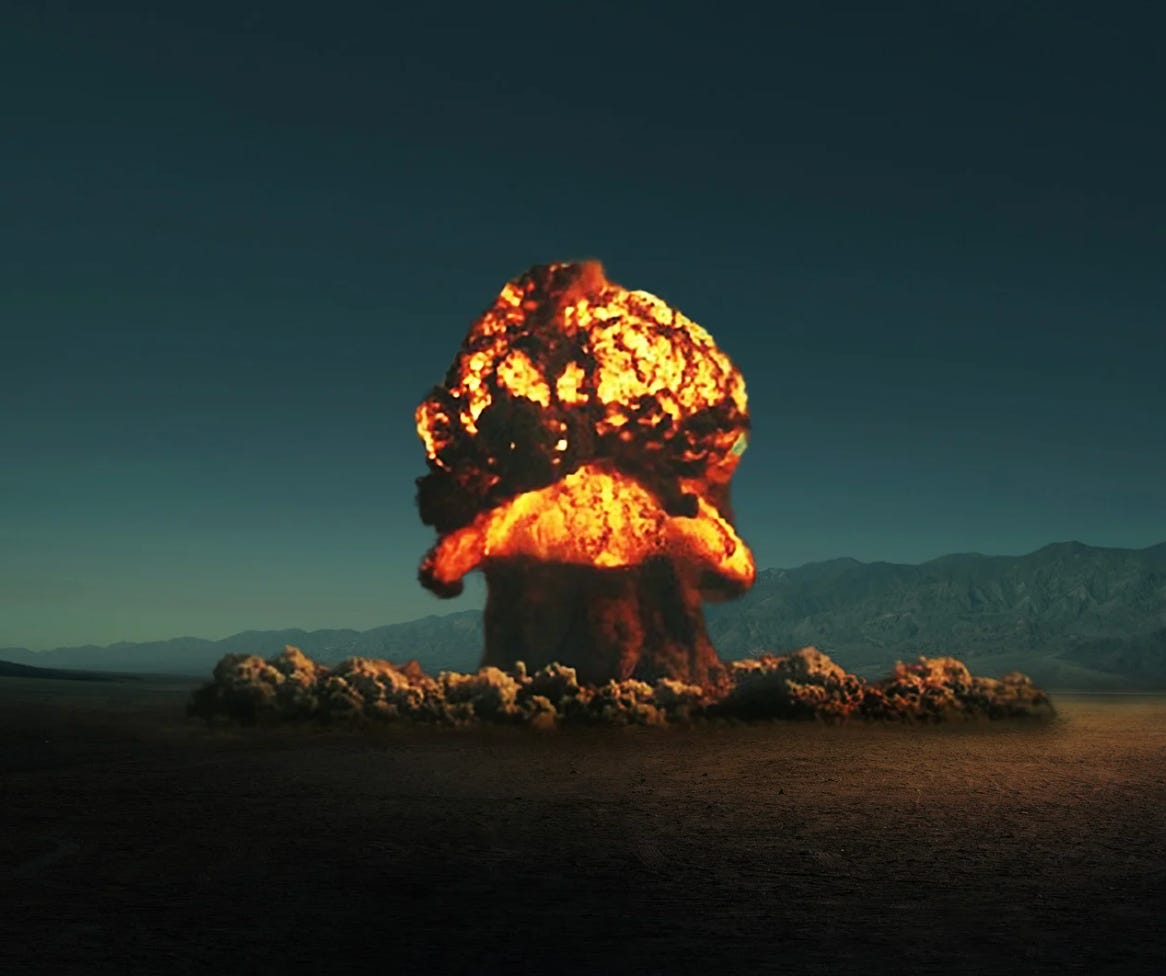
The sky opened like God’s mouth, and everything living learned how to die.

Dedicated to my mother, Lisa. In another lifetime, in another timeline, we would have had longer, we would have been better, we would have had what it seems like everyone else is promised. But even if in all the infinite universes, in all the impossible possibilities, if all our souls were ever promised was this one, I would still always choose you.
THE FLASH
The city feels too alive this morning, the kind of bright, swollen summer day where everything sweats and shines at the same time, where heat clings to your skin like a second body and the air smells faintly of hot metal, street food, and something rotting in the gutters. I am holding Callie’s hand as we wait at the crosswalk, her fingers small and damp in mine, sticky from the melted remains of a popsicle she insisted on finishing even as it ran down her wrist and onto her elbow. She is talking about something I’m only half listening to, something about a dog she saw in the park and how it looked like it was smiling, her voice light and continuous, like it has nowhere else to be.
I nod at the right moments, or I think I do. I tell her we can go back later, maybe bring bread for the pigeons, maybe sit for a while if the heat breaks. I say things like later and tomorrow without thinking about them, without understanding that I am spending something I do not own.
The light changes. The crowd shifts forward in that impatient, collective motion that defines this city, bodies brushing past each other, a hundred small lives intersecting without meaning. A man on his phone nearly collides with us, mutters an apology, keeps moving. A woman laughs too loudly at something in her headphones. A taxi honks even though there is nowhere for it to go. Everything feels ordinary in the way that only something about to end can feel.
Callie squeezes my hand. “Mommy, can we get ice cream after this?”
“You just had a popsicle.”
“That’s not the same.”
I smile despite myself, already forming the yes I will give her, already giving in, because there is always time for small indulgences, because saying no feels unnecessary when the day stretches ahead of us like something guaranteed.
But I never get the chance to say yes.
The world turns white.
It is not like sunlight. It is not like anything I have ever seen. It is as if the sky has split open and something behind it, something vast and merciless, has decided to look directly at us. The brightness is total, immediate and invasive. It pours into my eyes, through them, into my skull, bleaching thought itself. For a moment there is no city, no people, no sound, only that unbearable, impossible light pressing against me from every direction at once.
Callie makes a small, confused noise beside me, and I turn toward her instinctively, already moving before I understand why, already reaching.
The heat arrives before the sound.
It hits like a wall, like being shoved into an oven that has been waiting for us, preheated and patient. My skin prickles, then screams, then feels as if it is being peeled away by invisible claws. The air itself burns. I taste something sharp and metallic at the back of my throat as I inhale reflexively, and it feels like swallowing fire.
I yank Callie toward me, pulling her against my body, turning so that my back faces whatever this is, whatever has found us, my arms wrapping around her head, her shoulders, pressing her face into my chest. I can feel her breath against me, quick and startled, her small hands clutching at my shirt.
“Mommy?”
I don’t answer. I cannot. The light is still there, still inside my eyes even when I squeeze them shut, an afterimage burned into me that refuses to fade.
Then the world remembers how to make noise.
The sound does not come as a single thing but as a tearing, layered violence that seems to arrive from everywhere at once, a roar that is too large to belong to any one source, as if the city itself has begun to scream. The ground shudders beneath us. The air shifts, compresses, then explodes outward.
The shockwave hits.
It lifts us, or maybe it throws us, I cannot tell the difference, only that one moment I am standing and the next I am no longer connected to the ground, my body moving in a direction I did not choose. I tighten my grip on Callie, folding around her as much as I can, my shoulder taking the brunt of the impact as we slam into something hard and unyielding.
Pain flares, sharp and immediate, but it is distant compared to everything else. There is too much happening, too much breaking.
Glass erupts.
Windows shatter in a cascading chorus that fills the air with glittering fragments, thousands of tiny blades catching what remains of the light as they are propelled outward. I hear a hiss, a rain of something deadly, and then they are there, striking pavement, metal, flesh. Something cuts across the back of my arm, another across my cheek, thin, hot lines that begin to bleed almost instantly.
People are screaming.
They are everywhere, or they were. Now they are shapes moving through smoke and dust, some upright, some not, some running, some already still in ways that do not look natural. A man stumbles past us, his suit jacket on fire, the fabric curling and blackening as he slaps at it with hands that are already blistering. A woman lies on the ground a few feet away, her mouth open in a silent cry, her skin red and wet in a way that does not make sense, as if it has begun to slip from her body.
I push myself up, my arm shaking under the effort, Callie still clutched against me. She is crying now, a panic that cuts through everything else.
“Mommy, it hurts, it’s hot, it’s too hot!”
“I know,” I say, though I do not know anything except that we cannot stay here. “I know, baby, I’ve got you, I’ve got you.”
The sky is tormenting my gaze.
I look up for only a second, and I wish I hadn’t. There is something rising in the distance, something vast and blooming, a column of fire and smoke twisting upward into a shape that feels alive, its edges boiling, expanding, devouring the blue. It is beautiful in a way that makes my stomach turn, in a way that feels obscene.
There is no time to understand it.
Another blast rolls through the city, less immediate but still violent enough to rattle the bones in my body. Buildings groan. Somewhere, something massive collapses with a sound that reverberates through the ground and into my feet.
We have to move.
I force my legs to work, to remember how to carry me, and I start running.
I don’t pick a direction so much as I flee from where we are, from the open street, from the sky that has become something else entirely. My shoes slip on debris, on scattered glass and things I do not want to identify. I tighten my hold on Callie, one arm wrapped around her back, the other shielding her head as best I can.
“Close your eyes,” I tell her, my voice rough, urgent. “Close your eyes and hold on to me, okay? Don’t look, just hold on.”
She does. I feel her face press harder into my chest, her small fingers digging into my shirt as if she can anchor herself there.
The air grows thicker as we move, choked with dust and something darker, something that smells like burning plastic and rancid meat. It coats my tongue, my lungs, every breath a struggle against the instinct to cough, to stop.
I pass people who are no longer moving. I pass others who are, but not in ways that suggest survival, their bodies bent at wrong angles, their skin already blistering, peeling in patches that reveal raw, wet layers beneath. Someone reaches for me as I run by, their hand grasping at the air, their eyes wide and uncomprehending, and I regretfully do not stop. I cannot stop. I refuse to.
The street ahead is fractured, a jagged split running through the asphalt where something beneath has given way. Beyond it, I see the entrance to a subway station, the familiar green railing bent but still recognizable, the stairs descending into shadow.
Shelter. Underground. Away from the sky.
I aim for it without thinking.
Another gust of superheated air rolls through, carrying sparks, embers that land on exposed skin and cling there. One catches in Callie’s pigtail. I smell it before I see it, that sickening scent of hair burning. I slap at it frantically, my hand coming away with strands that stick to my skin.
“It’s okay,” I lie, because there is nothing else to say. “It’s okay, I’ve got you.”
We reach the stairs inside the station, a singed structure that is somehow still standing. I nearly miss the first step in my haste, my foot slipping, my balance faltering, but I catch myself against the railing, the metal so hot it sears my palm. I grit my teeth and keep going, half stumbling, half falling down into the dimness below.
The sound changes as we descend, the roar of the city muffled, transformed into something distant but no less terrifying. The air is cooler, marginally, though it still carries that same poisoned weight.
I do not stop until we are several steps down, until the entrance above us is partially obscured by the angle, by the thickening haze.
Only then do I sink to my knees, Callie still in my arms, both of us shaking.
Her face is buried against me, her small body trembling with each breath. I can feel the heat still radiating from her skin, from mine, a lingering burn that does not fade.
“Mommy,” she whispers, her voice thin and frayed. “What was that?”
I open my mouth to answer, to give her something that will make sense, something that will make this less than what it is, but there are no words that fit.
Above us, the sky has opened, and whatever has looked down has not looked away.
“I don’t know,” I say finally, the truth tasting like ash. “But we’re going to be okay. I promise.”
The lie settles between us, heavy and immediate, and somewhere deep inside me, beneath the adrenaline and the noise and the instinct to keep moving, something quiet and certain begins to break.
THE ASH
The silence comes slowly, like something settling into place after it has finished breaking everything.
At first there is still noise above us, distant collapses, the hollow thunder of things too large to name giving way under their own weight, the faint echo of sirens that never quite form into anything coherent. Then even that begins to thin, to stretch out into long, empty pauses, until the city that never knew how to be quiet forgets how to make sound at all. What remains is a low, constant hum that might only be in my head, a ringing that fills the absence and makes it feel like something is still happening even when nothing is.
I sit on the cold concrete steps with Callie curled into me, her small body pressed so tightly against mine that I can feel every shallow breath she takes. My arms ache from holding her, my shoulder throbs where I hit the ground, my skin stings in a way that does not fade, but I do not loosen my grip. If I let go, even a little, it feels like something will take her.
“We’re okay,” I say, because the words come automatically, because silence feels more dangerous than a lie. “We made it down here. We’re safe for now.”
She shifts slightly, lifting her face just enough to look at me. Her cheeks are flushed, brighter than they should be, her eyes wet and wide, searching mine for something solid to hold onto.
“Is it over?” she asks.
I hesitate for a fraction of a second, and then I nod. “The worst part is. We just have to stay down here for a bit.”
The words feel fragile as I say them, like they might collapse if I look at them too closely. I do not look at them. I focus on her, on the weight of her in my arms, on the simple fact that she is still here.
Above us, something drifts past the opening of the station entrance, slow and soft, catching what little light filters down.
At first I think it is dust.
Then more of it follows, thickening, gathering, falling in a steady, unnatural descent.
It looks like snow.
Callie turns her head to follow my gaze, her expression shifting from fear to something softer, something almost curious. “It’s snowing,” she says, her voice small but threaded with a kind of wonder that makes my chest tighten.
“It’s not snow,” I tell her quickly, too quickly, the correction instinctive and sharp. “It’s just… ash. From the buildings.”
She watches it for a moment longer, the pale flakes drifting down in slow spirals, settling on the broken steps, on the bent railing, on the edges of the world we have retreated into.
“It’s pretty,” she says.
I swallow against the taste in my mouth, something bitter and metallic that has been there since the light, since the heat, as if I have been chewing on something I cannot spit out. “Don’t touch it,” I say, softer now. “Okay? Just leave it alone.”
She nods, though I can see the question in her eyes, the quiet confusion that has not left her since the sky changed.
I shift, forcing myself to stand, my legs unsteady beneath me. We cannot stay on the stairs forever. We need water. We need something to eat. We need to be farther from the open air, even if I do not fully understand why the thought of that falling ash makes something deep inside me recoil.
“Come on,” I say, adjusting my hold on her, letting her feet find the ground but keeping her close. “Let’s see what’s down here.”
The station is dim, lit only by the weak, flickering remnants of emergency lights that cast everything in a sickly, uneven glow. The familiar shape of it feels wrong now, stretched and hollowed out, the tiled walls smeared with soot, the air thick with dust that clings to the back of my throat. There are people here, or there were, their presence marked by discarded bags, a shoe lying on its side near the platform, a phone still lit on the ground with no one to claim it.
A man sits slumped against a pillar a few yards away, his head tilted at an angle that suggests sleep until I notice the way his chest does not move. I turn Callie slightly, guiding her gaze away before she can focus on him.
We move slowly, my free hand trailing along the wall for balance, for something solid to anchor me as I scan the space for anything useful. A vending machine stands near the far end of the station, its glass cracked but not entirely shattered, its contents still visible behind the fractured surface.
Food.
The word feels absurd in my mind, too normal for what is happening, but I cling to it anyway. Normal things mean normal outcomes. Normal outcomes mean we can survive this.
I approach it carefully, setting Callie down just long enough to free both hands. She stays close, her fingers curling into the fabric of my shirt as if she can tether herself to me.
“Stay right here,” I murmur, though she is already doing exactly that.
The machine resists at first, the metal frame bent just enough to make the door difficult to open, but adrenaline lends me strength I do not question. I pry at it, ignoring the protest in my shoulder, until something gives with a sharp, tearing sound. The door swings open unevenly, and I reach inside, grabbing whatever I can without looking too closely, packets of chips, candy bars, things that will not help in any meaningful way but feel like something.
Callie watches me with quiet intensity. “Can I have one?” she asks.
“In a minute,” I say, stuffing the food into my bag, my hands shaking more than I want them to. “We’ll find some water first.”
Water.
The word brings with it a sudden wave of nausea that catches me off guard. It rises quickly, violently, forcing me to brace myself against the machine as my stomach twists. For a moment I think I am going to vomit, the sensation so immediate and overwhelming that it steals my breath.
I swallow it down, hard, forcing it back with a stubbornness that feels almost panicked. It is nothing, I tell myself. Shock. Stress. Too much happening at once.
“Mommy?” Callie’s voice is uncertain. “Are you okay?”
I straighten, wiping my mouth with the back of my hand, though there is nothing there yet. “I’m fine,” I say, the lie smoother this time, easier. “Just a little dizzy. It’s a lot, you know?”
She nods, accepting it because she has always accepted what I tell her, because I have always given her a world that makes sense.
We find water in a maintenance closet, a few plastic bottles left behind, dusty but intact. I twist one open and take a cautious sip, the liquid warm and faintly plastic-tasting, but it is something. I hand another to Callie, watching as she drinks greedily, some of it spilling down her chin.
“Slow down,” I say gently, brushing the excess away with my thumb. Her skin is hot beneath my touch, warmer than it should be, flushed in a way that makes my stomach tighten again.
“Are you hot?” I ask.
She nods, her expression pinching slightly. “It still feels like the sun is on me.”
I press the back of my hand to her forehead, then her cheek. The heat there is not just from the day, not just from what happened. It lingers, trapped beneath her skin.
“It’ll pass,” I tell her, because I have to. “Your body’s just… reacting.”
To what, I do not say. To what, I do not let myself fully think.
I take another drink of water, and the metallic taste blooms again, stronger now, coating my tongue, sliding down my throat. I grimace, swallowing it anyway, because thirst is worse, because we need to stay hydrated, because these are the kinds of thoughts that belong to a world that still follows rules.
We settle against the wall, a few feet from the platform edge, far enough from the entrance that the falling ash does not reach us directly, though I can still see it drifting down in the distance, an endless, silent snowfall that does not melt.
Callie leans into me, her head resting against my arm. “When can we go home?” she asks.
The question feels heavier than anything else so far, heavier than the light, the heat, the noise. Home is still standing in my mind, still intact, our kitchen, her room, the small bed with the faded sheets she insisted on keeping even as she outgrew them. I picture it as it was this morning, sunlight through the window, the quiet hum of the refrigerator, the ordinary safety of it.
“We will,” I say, my voice soft, steady in a way I do not feel. “Just not yet. We have to wait until it’s safe outside.”
She accepts this too, because she trusts me to know what safe means.
Her eyes begin to droop, the adrenaline that carried her this far finally ebbing, leaving behind exhaustion that settles into her small frame. She curls closer, her breathing evening out, though there is a slight hitch to it now, a faint irregularity that I notice only because I am listening so carefully, because every part of me is tuned to her.
I brush her hair back from her face, my fingers catching slightly on strands that feel dry, brittle at the ends where the heat kissed them. She stirs but does not wake, her body surrendering to sleep despite everything.
I watch her for a long time, tracing the familiar lines of her face, committing them to memory in a way I have never felt the need to before.
A memory rises unbidden, soft and warm and impossibly distant.
She is small enough to fit entirely in the crook of my arm, her head no larger than my palm, her skin impossibly smooth, untouched by anything harsher than air. The hospital room is quiet, filled with that gentle, artificial light that makes everything feel suspended, protected from the outside world. She opens her eyes for the first time, unfocused, searching, and then somehow finding me anyway, her tiny fingers curling reflexively around mine.
I remember thinking, with a certainty that felt absolute, that I would always be able to keep her safe.
The memory fractures.
I am back in the dim, dust-choked station, the air heavy, the silence oppressive. The taste in my mouth grows stronger, more insistent. My stomach twists again, sharper this time, and I press my lips together, breathing slowly through my nose as I try to keep it at bay.
My skin burns.
It is not the immediate, searing heat from before but something deeper, more persistent, as if the burn has settled into me, into my cells, into places I cannot reach. I glance down at my arm, at the exposed skin between the cuts left by glass.
It is red.
Not in patches, not where I was scraped or struck, but evenly, unnaturally flushed, as if I have been standing in the sun for hours without realizing it.
I rub at it with my thumb, but it doesn’t fade.
“It’s nothing,” I whisper to myself, the words barely sound at all. “It’s just… from before.”
From the heat. From the light. From everything that happened in those few impossible seconds.
Above us, the ash continues to fall, steady and unrelenting, covering the world we cannot see in a layer that looks almost gentle from this distance.
I pull Callie closer, pressing my lips to the top of her head, inhaling the faint, familiar scent of her beneath the smoke and the dust.
“We’re okay,” I murmur into her hair, the lie softer now, almost tender in the way it settles between us. “We’re going to be okay.”
The words hang there, fragile and thin, and in the quiet that follows, I begin to understand that whatever has started above us did not end with the light.
THE SICKNESS
It begins with the taste.
It never leaves, not even when I sleep, not even when I force water down my throat until my stomach sloshes and protests. It sits there, thick and metallic, like I have been sucking on coins, like something inside me has started to rust. I wake with it, swallow it, try to ignore it, but it grows stronger with every hour, spreading into everything, into the air, into the water, into the back of my thoughts where it festers and waits.
Callie wakes crying.
At first it is soft, a whimper pulled from sleep, her body curling inward as if she can make herself smaller, but then it sharpens, breaks open into something raw and frightened. I am already moving before I am fully conscious, pulling her into my lap, pressing my hand to her forehead.
She is burning.
Not with the lingering heat from before, not with anything that feels external, but with something that has taken root beneath her skin and is feeding on her from the inside. Her face is flushed an angry red, her lips dry and cracked, her eyes glassy in a way that makes my chest tighten.
“Mommy,” she whispers, her voice hoarse, weaker than it should be. “My tummy hurts.”
“I know,” I murmur, brushing her hair back, though the strands cling strangely to my fingers, dry and fragile. “It’s okay. It’s just… your body’s a little shaken up. It’ll pass.”
The lie comes slower now. It drags against something inside me that is beginning to resist, something that has started to understand.
She shakes her head weakly, her small hands clutching at her stomach. “It really hurts.”
I reach for one of the water bottles, unscrewing the cap with fingers that feel clumsy, less responsive than they should. “Take a sip,” I say gently, guiding it to her lips. “Just a little.”
She obeys, because she always does, taking a small swallow that she immediately regrets. Her face twists, her body jerking forward as a violent wave of nausea overtakes her.
I barely have time to turn her before she vomits.
It comes suddenly, forcefully, splattering against the concrete beside us, a thin, watery mess that smells sour and sorrowful. She chokes on it, coughing, her body convulsing with the effort, tears streaming down her face.
“It’s okay,” I say quickly, holding her upright, rubbing her back in small, desperate circles. “It’s okay, it’s okay, just get it out.”
She retches again, though there is almost nothing left to bring up, her small frame shaking with each heave. I feel it then, the echo of it in my own body, the same nausea rising, clawing its way up my throat with a sudden, undeniable force.
I turn away from her just in time, one hand braced against the wall as my own stomach empties itself in a harsh, uncontrollable rush. The taste is worse now, overwhelming, flooding my mouth and nose until I gag on it, until my eyes water and my vision blurs.
For a moment, all I can do is breathe, shallow and uneven, my body trembling with the aftermath.
Then I remember.
I wipe my mouth with the back of my hand and turn back to her immediately, ignoring the dizziness that follows the movement, the way the world tilts slightly before settling again.
“I’m right here,” I say, pulling her close again, cradling her against me. “I’m right here, baby.”
She is crying softly now, her energy already draining from her, leaving behind a weak, trembling version of herself that feels too small in my arms.
“I don’t like it,” she whispers.
“I know,” I say, pressing my lips to her temple. Her skin is hotter than before, the heat radiating from her in waves. “I don’t like it either.”
Time becomes something strange after that, something that stretches and folds in on itself, marked only by the intervals between her getting sick, between my own body betraying me in the same way. The station feels as if it’s closing in around us, each breath of noxious air a labored effort.
Her symptoms worsen quickly.
The redness in her skin deepens, spreading across her arms, her face, her neck in a uniform flush that looks almost like a severe sunburn, except it does not fade, does not cool. When I touch her, she flinches, her body recoiling from even the gentlest contact.
“It hurts,” she says again, over and over, the words becoming a refrain that I cannot silence.
I try everything I can think of, dampening a piece of cloth with water and pressing it to her forehead, her wrists, whispering reassurances that feel farther each time I say them. I count her breaths. I count mine. I tell myself that this will pass, that bodies can endure more than we think, that children are resilient.
Her eyes grow red.
At first it is subtle, a slight irritation that I attribute to the dust, the ash that still drifts down somewhere above us, but then the whites of her eyes begin to darken, veins blooming across them in terrifying patterns. She blinks more often, her gaze unfocused, struggling to settle on anything for long.
“Mommy,” she says at one point, her voice distant, as if she is speaking from somewhere slightly removed from herself. “Why does everything look funny?”
My throat tightens. “What do you mean, baby?”
“It’s… blurry,” she murmurs, her brow furrowing. “And it hurts when I look at the light.”
I shift her slightly, angling her away from the dim flicker of the emergency lamps, though they barely illuminate anything at all.
“It’s okay,” I tell her, though the words are starting to feel like a ritual rather than a reassurance. “Just rest your eyes for a bit.”
She nods weakly, letting them fall closed, her lashes sticking together in a way that makes my stomach twist.
I notice the hair next.
It happens gradually, so subtly that at first I think I am imagining it. A strand clings to my fingers when I brush her forehead again. Then another, and another, until I realize they are not just loose, they are detaching with almost no resistance at all.
I freeze for a moment, staring at the fine, dark strands against my skin.
No.
The word is immediate, absolute. It rises from somewhere deep and primal, a rejection of what I am seeing, what I am beginning to understand.
No.
I gently smooth her hair back again, more carefully this time, as if that will change something, as if I can will it to stay where it belongs.
She stirs, her eyes fluttering open again. “Mommy, I’m tired.”
“I know,” I say, my voice softer now, strained at the edges. “You can sleep. I’ve got you.”
She shifts in my arms, her body heavier than it should be, not in weight but in the way she yields, in the way the energy has drained from her completely. Her head lolls slightly against my shoulder before settling.
I hold her, listening to her breathing, counting the seconds between each inhale, each exhale, as if I can keep them coming by sheer will.
My own body is not faring better.
The dizziness comes in waves now, sudden and disorienting, forcing me to close my eyes until it passes. My skin burns more intensely, the redness deepening into something rawer, more inflamed. When I glance down at my arm again, I see small blisters beginning to form along the surface, clear and disturbingly dead.
I press my lips together, swallowing hard against the nausea that never fully recedes.
This is not shock.
The thought arrives fully formed, undeniable in a way that cuts through every layer of denial I have built.
This is something else.
A memory pushes forward, uninvited and cruel in its clarity.
Callie is standing in the middle of the living room, her legs unsteady, her tiny hands reaching out toward me as if I am the only thing anchoring her to the world. She wobbles, her face scrunching in concentration, in determination, and then she takes a step. It is small, uncertain, but it is hers.
“Look,” I had said to no one, to everyone, my voice thick with a kind of joy that feels impossible now. “She’s walking.”
She had laughed then, a bright, bubbling sound that filled the room, that made everything else feel secondary.
She takes another step, then another, until she collapses into my arms, triumphant and unafraid.
I blink, and the memory shatters.
In its place is the weight of her now, limp and feverish against me, her breath shallow, her skin too hot, too fragile.
Her gums begin to bleed.
It starts as a faint smear at the corner of her mouth, something I almost miss until she shifts and I see the dark red against her lips. My heart stutters, a sharp, painful beat that echoes in my ears.
“Open your mouth for me,” I say gently, my hands trembling as I tilt her chin up.
She obeys, sluggishly, and I see it then, the thin line of blood along her gums, seeping from places that should not be bleeding at all.
Panic surges, hot and immediate.
“No,” I whisper, the word breaking as it leaves me. “No, no, no…”
I wipe at it with my thumb, as if I can erase it, as if it is something external, something that does not belong to her.
It comes back.
It doesn’t stop.
My own mouth tastes bruised now, the metallic edge deepening into something more substantial. I swallow reflexively and feel a slight wetness along my own gums, a tenderness that was not there before. I am drinking my own decaying flesh.
The understanding settles in fully then, heavy and suffocating.
This is not something we can wait out.
This is not something that will pass.
This is not something I can fix.
I pull her closer, wrapping my arms around her as tightly as I can without hurting her, pressing her against me as if I can hold her together, as if I can keep her from slipping away piece by piece.
“I’m here,” I whisper into her hair, though it comes away against my lips, strands sticking there in a way that makes my stomach lurch. “I’m right here. I’m not going anywhere.”
She makes a small sound in response, something that might be agreement, might be nothing at all.
The station around us feels like a tomb now, the walls closing in, the air thick with the quiet that has replaced the city.
I press my forehead to hers, closing my eyes.
There is a word for this.
It sits just out of reach, something I learned once, something I never thought I would need to remember. It hovers there, heavy with implication, with finality.
When it finally surfaces, it does so with a clarity that steals what little breath I have left.
Radiation.
The word feels like a sentence to Hell.
I hold her tighter, as if I can shield her from it now, as if I am not already full of it myself, as if it has not already begun its work inside both of us.
“We’re going to be okay,” I whisper again, but this time the words collapse as I say them, crumbling under the weight of what I know.
For the first time since the sky opened, I understand that there is no version of this where we walk out of here alive.
THE ROT
Time stops behaving like something that moves forward.
It folds in on itself, stretches, collapses, becomes something thick and unmoving that we are trapped inside of, measured only by the worsening of our bodies, by the way each breath feels harder than the last. There is no day or night down here anymore, only the dim, flickering light that never fully dies and never fully brightens, casting everything in the same sick, unchanging glow. I do not know how long it has been since the sky opened. Hours. Days. It no longer matters. The only clock left is what is happening to her.
Callie whimpers in her sleep, a soft, broken sound that no longer resembles the voice she had before, and I tighten my hold around her instinctively, though even that small movement sends a wave of pain through my arms, through my chest, through places that feel like they are coming apart beneath my skin. My body no longer belongs to me in any meaningful way. It has become something fragile and unreliable, something that reacts without permission, that punishes me for every attempt to use it.
She is lighter now.
Not in the way that comes from losing weight, but in the way something becomes light when it is starting to leave, when whatever anchored it begins to loosen its grip. When I adjust her in my lap, she yields too easily, her limbs slack, her head lolling before I catch it, guiding it gently back against my shoulder.
“Mommy,” she murmurs, her voice drifting in and out of something deeper than sleep. “It hurts.”
“I know,” I whisper, my lips brushing what remains of her hair. It comes away against my skin again, more of it now, bloody clumps that detach without resistance, leaving behind patches of scalp that look too pale in some places, too red in others. “I know, baby. I’m right here.”
Her skin has begun to change in ways I can no longer pretend are anything else.
The redness has darkened, deepened into something mottled and uneven, patches of angry color spreading across her arms, her legs, her face. The blisters that once sat like fragile bubbles on the surface have ruptured, leaving behind raw, wet areas that glisten in the dim light, the outer layers of her skin separating, loosening, as if her body is forgetting how to hold itself together.
When I touch her now, even as gently as I can manage, pieces of her come with it.
I learn quickly not to move her more than necessary, not to drag fabric across her, not to do anything that might worsen what is already happening. I use what little water we have left to dampen cloth and press it against the worst of it, trying to soothe, to cool, though the relief it offers is brief and uncertain.
The smell is different now.
It has changed from smoke and dust to something heavier, something spoiled and sickening that lingers in the air around us, clinging to my throat, to the inside of my nose. It is the smell of something breaking down while it is still alive, something that should not be happening but is.
Callie stirs again, her eyes opening slightly, unfocused and glassy. The red in them has deepened, the whites now threaded with dark, spreading lines that make it look as if something is blooming beneath the surface.
“Mommy,” she says, her voice distant, as if she is speaking from far away. “Why can’t I feel my legs?”
My heart stutters, then drops into my stomach.
I shift slightly, trying to gauge her response, but she does not react when I touch her lower leg, does not flinch, does not move.
“It’s okay,” I say, the words automatic, hollow. “You’re just tired. Your body’s resting.”
She nods faintly, accepting it, because she no longer has the strength to question, because she trusts me even now.
I swallow against the thickness in my throat, against the copper taste that has become something more, something wet. When I cough, it comes up, dark and unmistakable, streaking across my hand.
I do not let her see.
My own skin has begun to split.
It starts along my arms, along the areas that were most exposed, the redness giving way to blistering that has now broken, leaving behind raw patches that sting and throb with every movement. In some places, the skin has begun to peel away in thin, translucent sheets, curling at the edges, revealing the darker, wetter layers beneath.
I try not to look at it for too long.
Looking makes it real in a way that I cannot afford.
Callie’s breathing grows more uneven, each inhale shallow, each exhale delayed, as if her body is forgetting the rhythm it has followed since the moment she was born. I count them still, though the numbers blur, though I lose track and start again and again.
“Stay with me,” I whisper, pressing my forehead to hers. “Stay with me, okay?”
She makes a small sound, something like agreement, something like a sigh.
Her gums bleed more now.
It is no longer a thin line but a steady seep, staining her lips, her teeth, the corners of her mouth. When she tries to swallow, she winces, her face tightening in a way that makes something inside me fracture further.
“Does it hurt to swallow?” I ask, though I already know the answer.
She nods weakly.
I wet the cloth again, pressing it gently to her lips, letting a small amount of water soak in, enough to ease the dryness without forcing her to drink.
“You’re doing so good,” I murmur, the praise soft and desperate. “You’re so strong.”
The words feel wrong, misplaced, but I say them anyway, because they are all I have left to offer.
My mind begins to slip.
It happens gradually, almost imperceptibly at first, a blurring at the edges of my thoughts, a difficulty in holding onto a single idea for too long. Then it deepens, fragments overlapping, memories intruding with a clarity that feels sharper than the present.
I see her as she should have been.
Not as she is now, not broken and fading in my arms, but older, taller, her hair longer, her voice steadier. I see her standing at the door with a backpack slung over her shoulder, rolling her eyes at something I have said, though there is affection in it.
“Mom, I’m going to be late,” she says, her voice carrying that easy impatience that belongs to a future we were supposed to reach.
“Did you pack your lunch?” I ask, because that is the kind of question that fills ordinary mornings.
She groans, dramatic, alive. “Yes. You asked me three times.”
I laugh in the memory, reaching out to fix her collar, to smooth her hair, to hold onto her for just one more second before letting her go.
The image shifts.
A birthday cake, candles flickering in a darkened room, her face glowing in their light as she leans forward, eyes closed, making a wish she does not tell me. Friends crowd around her, their voices overlapping in a chorus of celebration that feels impossibly loud, impossibly bright.
“What did you wish for?” I ask.
“If I tell you, it won’t come true,” she says, smiling in a way that suggests she already knows it will.
The memory fractures.
I am back in the dim, choking stillness of the station, her body small and fragile against mine, her breath shallow, her skin breaking down beneath my hands.
None of that will happen.
The realization settles fully now, no longer something I can push away, no longer something I can soften with lies.
There will be no school mornings, no birthdays, no growing up.
There is only this.
Callie stirs again, her eyes opening wider this time, though they do not seem to focus on me. They drift past me, past the walls, as if she is looking at something I cannot see.
“Mommy,” she says softly. “Is that the park?”
My chest tightens. “What do you see, baby?”
“The swings,” she murmurs, a faint smile touching her lips despite everything. “They’re moving.”
There is no park here.
There are no swings.
“It’s okay,” I say, my voice breaking despite my effort to hold it steady. “You can watch them.”
She nods slightly, her gaze still fixed on something beyond me.
I pull her closer, ignoring the pain, ignoring the way my own body protests, the way my strength is fading with each passing moment.
I understand now.
There is no saving her.
There is no saving me.
All that remains is this small, fragile space where she is still here, where I can still hold her, where I can still be her mother in the only way that matters now.
“I’m right here,” I whisper again, over and over, the words becoming a rhythm, a tether. “I’m right here. I’m not leaving you. I’m not letting you be alone.”
Her breathing stutters, falters, then resumes, weaker.
I press my lips to her forehead, tasting salt, tasting something else beneath it, something that should not be there.
If there is a God, I think, the thought drifting through the haze of my mind, it is not one that watches. It is not one that listens. It is something distant, something absent, something that allowed this to happen without interruption, without mercy.
Or maybe there is nothing at all.
Maybe this is what we have always been, what we have always done, building toward a moment where the sky opens and everything living learns how to die.
Callie shifts in my arms, her body barely responding now, her breath nothing more than a fragile thread.
“I’m sleepy,” she whispers.
“I know,” I say, tightening my hold around her, anchoring her to me with everything I have left. “You can rest. I’ve got you. I’ve always got you.”
And even as my own body begins to fail in ways I can no longer ignore, even as the world narrows to this dim, suffocating space, I hold on to that one, stubborn truth.
She will not die alone.
THE RUIN
Her breathing is so light now I keep thinking I’ve lost it, that it slipped out of her without me noticing, that I looked away for one second and that was all it took for the world to finish taking her. I hold her closer each time the silence stretches too long, pressing my ear to her mouth, my cheek to her forehead, feeling the heat that has nowhere left to go, the fever burning through a body that doesn’t have the strength to fight it anymore. The air tastes like my own body’s rot, and every breath I take feels borrowed, but I keep taking them because she is still here and that has to mean something, even now, even at the end of everything.
Her fingers twitch against my wrist, slow and uncertain, like she’s trying to remember how to move them, and I wrap my hand around hers before she can lose the thought entirely. Her skin is unfamiliar beneath my burning touch, too soft in some places, too fragile in others, peeling where I try not to look, and I hate my own hands for not knowing how to hold her without hurting her. I tell her it’s okay anyway. I tell her I’ve got her. I tell her the same lies I’ve been telling since the sky opened and decided we didn’t belong here anymore.
“Mommy,” she whispers, her voice so fragile it barely disturbs the air between us, and I lean down immediately, like I can catch the sound before it disappears.
“I’m right here, baby,” I say, and my voice sounds steadier than I feel, like it belongs to someone who still believes in anything beyond this room, beyond the gray light pressing through the broken windows, beyond the ash that keeps falling and falling like the world forgot how to stop.
“Does it hurt where we’re going?”
The question settles inside me, heavy and impossible, and for a moment I can’t breathe around it. I smooth her hair back, or what’s left of it, strands coming loose between my fingers, and I try to remember how to answer something like that in a way that doesn’t break her, in a way that doesn’t admit that I don’t know where we’re going, or if there is anywhere at all.
“No,” I tell her softly, because I have to give her something, because she deserves at least that. “No, it doesn’t hurt. It’s warm. It’s quiet. You’ll be safe.”
Safe. The word feels like a memory from another life, something I used to believe in without thinking, like locking doors mattered, like holding her hand in the street was enough to keep her here forever. I press my lips to her temple and taste salt and sickness and the faint, bitter trace of something burned into her skin from the inside out, and I close my eyes so she won’t see the way my face folds in on itself.
“I’m so tired,” she murmurs, her eyelids fluttering, the whites of her eyes streaked red, unfocused in a way that makes my chest tighten until it feels like it might split open.
“I know,” I whisper. “You can rest. I’m right here. I’m not going anywhere.”
I say it like a promise, even though I know it’s a lie we’re both about to keep.
For a moment, just a moment, I see her the way she was before any of this, before the heat and the light and the sickness that followed us into every corner we tried to hide in. I see her standing in the living room, wobbling on unsteady legs, her hands reaching for me with that fierce determination only she had, her laugh breaking out of her like something unstoppable when she finally took those first steps into my arms. I remember the weight of her then, solid and whole and alive in a way that didn’t feel temporary, and I try to hold that version of her over the one in my arms now, like I can choose which one is real if I concentrate hard enough.
Her grip loosens.
It’s small at first, just a soft slackening of her fingers against mine, but I feel it immediately, like a thread snapping somewhere deep inside me. I tighten my hold without thinking, cradling her hand, her face, the curve of her body against mine as if I can anchor her here through sheer force, as if love has any weight left in a world that has burned everything else away.
“Callie,” I say, a little louder now, not enough to scare her, just enough to pull her back if she’s drifting somewhere I can’t follow. “Hey, stay with me. Just a little longer, okay? Stay with Mommy.”
Her chest rises, shallow and uneven, and then falls.
There is a pause.
Another breath, smaller this time, like her body is forgetting the pattern.
Then nothing.
I wait for the next one, holding still, counting without realizing I’m counting, my own breath caught somewhere between in and out, suspended in a space where time hasn’t decided what it wants to do yet. I press my hand to her chest, then to her throat, searching for something, anything, some sign that I’ve made a mistake, that I missed it, that she’s still here and I just need to try harder to find her.
“Callie,” I say again, softer now, because the sound of her name feels fragile in the silence. “Baby, breathe.”
She doesn’t.
The world doesn’t react. The ash keeps falling outside, drifting past the shattered glass in slow, endless sheets, the city stretching out beyond us in a gray, unmoving expanse of ruin. There are no sirens, no voices, no footsteps echoing through the streets, no sign that anything notices the exact moment my daughter leaves the world behind.
I pull her closer anyway, pressing her against my chest, rocking her the way I did when she was small and scared of thunderstorms, when noise still meant something, when fear had edges we could see and name and survive. I hum without thinking, a broken, tuneless sound that vibrates through my ribs and into her, as if some part of her might still hear it, might still recognize me.
“I’ve got you,” I whisper into her hair. “I’ve got you, I’ve got you, I’ve got you.”
The words lose their meaning the longer I say them, until they’re just sound, just breath, just something to fill the space where her voice should be.
My body is failing in worse ways now, things I would have panicked over before reduced to distant, dull sensations that flicker at the edges of my awareness. My gums bleed when I swallow, the taste thick and coppery, and when I shift even slightly I feel the pull of skin that doesn’t want to stay where it belongs. My head swims, the room tilting and settling in slow, nauseating waves, but none of it feels urgent anymore. There is nothing left to fix. There is nowhere left to go.
I rest my cheek against her and close my eyes, letting the darkness come in gently this time, without fighting it, without trying to claw my way back toward something that isn’t there anymore. Images move through me in fragments, disjointed and soft at the edges, her laugh, her first word, the way she used to press her face into my neck when she was sleepy, the warmth of her small body curled against mine in a bed that felt like the safest place in the world.
I try to hold onto those pieces, to stack them together into something whole, something that proves she was here, that she mattered, that we both did, even if the world ends without remembering us.
“I’m right behind you,” I murmur, though my lips barely move, the words dissolving as soon as they leave me. “You’re not alone.”
I don’t know if there’s anything waiting. I don’t know if there’s a place where the air is clean and the light doesn’t burn and bodies don’t betray themselves. I don’t know if there’s a God who saw all of this and chose it anyway, or if there’s nothing at all, just the long echo of what we did to each other ringing out until even that fades.
All I know is that she shouldn’t be there by herself.
The last thing I feel is the weight of her in my arms, lighter than it should be, and the steady, silent fall of ash beyond the broken walls, covering the streets, the buildings, the empty cars, the bones of a city that once believed it was untouchable. It settles over everything without urgency, without purpose, soft as snow and just as indifferent, until there is no movement left, no sound, no breath, only a stillness so complete it feels like the world has finally stopped trying to be anything at all.
And then I am gone too, and the quiet takes us both.
If you enjoyed this story, consider subscribing.
New whimsical, funny, eerie, and thrilling short stories and serialized novellas arrive straight to your inbox, so you never miss a chapter.
©️ 2026 Lee Stackhouse
For rights questions contact: leestackhouseauthor@gmail.com
I don't even have words to say. People have actually experienced what you described. That's the true horror. This is going to sit with me for a while.
Really well done.